The hilltop of Tell Baalbek, part of a valley to the east of the northern shows signs of almost continual habitation over the last 8–9000 years.
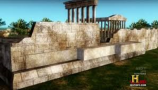
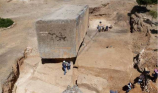
The complex is located on an immense raised plaza erected 5 m (16 ft) over an earlier T-shaped base consisting of a podium, staircase, and foundation walls These walls were built from about 24 monoliths, at their lowest level weighing approximately 330 tons each. The tallest retaining wall, on the west, has a second course of monoliths containing the famous “Three Stones” a row of three stones, each over 19 m (62 ft) long, 4.3 m (14 ft) high, and 3.6 m (12 ft) broad, cut from limestone. They weigh approximately 880 tons each. A fourth, still larger stone is called the Stone of the Pregnant Woman: it lies unused in a nearby quarry 2,600 ft from the town. Its weight, is estimated at 1,100 tons. A fifth, still larger stone weighing approximately 1,300 – 1,650 tons lies in the same quarry.
The Three Stones weighing about 880 tons each.
How were these stones lofted in place?
Who did it and when?
Massive 1,100 ton Stone of the Pregnant woman that remains near the quarry.
Largest man made stone block at Baalbek estimated at 1,300 – 1,650 tons!
My Eight Wonders (Con’t) Sacsayhuaman & Ollantaytambo
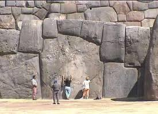
Sacsayhuaman (AKA the Fortress) is located approximately 990 feet above the city of Cusco, Peru (elevation: 11,152 ft). Current accepted theory is that it was constructed by the Inca’s circa 1500 CA. Keep in mind that the Inca civilization only lasted for 98 years (1438 – 1533 CA). The theory is that the massive stones were quarried over ten km away across a valley and a river. They were dragged using brut force to the site (some of the slopes from Cusco to the site exceed 40 degrees!) and are carved to fit together so precisely that not even paper will fit in the joints. No mortar was used.
I’m not the only person who thinks this theory is bizarre. I have had the opportunity to visit the site on two occasions and have a third trip planned.
The Largest stone is estimated to weigh 300 tons. Some of the stones have over a dozen angles that required precise matching with all of the adjacent stones. Regardless of when this project occurred or who accomplished the feat it is absolutely amazing and one that I doubt we could reproduce even with our current technology.
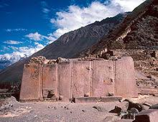
The main quarries of Ollantaytambo (see below) were located at Kachiqhata, in a ravine across the Urubamba River some 5 km from the town. The construction and preciseness is identical to that at Sacsayhuaman. How did they transport stones exceeding 50 tons from a site on the mountain across the river?
Called “Potbelly Hill” by locals for its gently sloping curves, Göbekli Tepe appears almost insignificant, a place of little prominence compared to any other mountain in its range. And yet, beneath the tawny earth of the mountaintop lies an astonishing discovery: a temple predating the earliest known place of worship by almost 5,000 years. In a time before pottery, agriculture, or even invention of writing, people came together to construct this monumental work of human ingenuity. Hidden for millennia after being hastily buried by its worshipers, Göbekli Tepe was far beyond its time both in architecture and in artistry, and with five percent excavated, is only slowly revealing its secrets.
Göbekli Tepe is regarded as an archaeological discovery of the greatest importance, since it profoundly changes our understanding of a crucial stage in the development of human societies. Contradicting all prior theories and research, the erection of monumental complexes was in fact well within the capacities of hunter-gatherers, and not only of sedentary farming communities as had been previously assumed. In other words, as the late Project Director Klaus Schmidt puts it: “First came the temple, then the city.” While this revolutionary hypothesis will have to be supported or modified by future research, the field of archaeology has been invigorated by what is arguably the world’s first great monument. The circa 300-meter-wide hill of Göbekli Tepe is situated approximately 15 kilometers northeast of the modern town of Şanlıurfa in southeastern Turkey. Though buried for thousands of years, the site of Göbekli Tepe has a foregone majesty that is not difficult to imagine: with an advantageous placement at the highest point of an elongated mountain range, it would have been an epic landmark for miles around. Indeed, when an American archaeologist first stumbled upon the ruins in the 1960s, he was so confused by his findings and where he found them that he walked away and never returned.