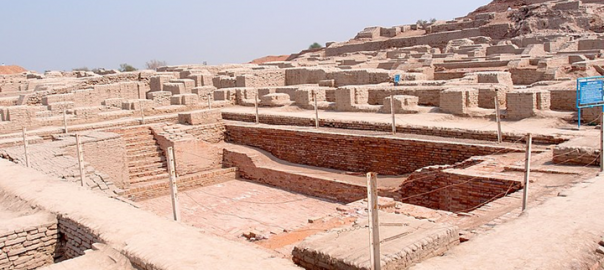
Mohenjo Daro
Meaning ‘Mound of the Dead Men, is an archaeological site in the province of Sindh, Pakistan. Built around 2500 BCE, it was one of the largest settlements of the ancient Indus Valley Civilisation, and one of the world’s earliest major cities, contemporaneous with the civilizations of ancient Egypt, Mesopotamia, Minoan Crete, and Norte Chico. Mohenjo-Daro was abandoned in the 19th century BCE as the Indus Valley Civilization declined, and the site was not rediscovered until the 1920s. Significant excavation has since been conducted at the site of the city, which was designated a UNESCO World Heritage Site in 1980. The site is currently threatened by erosion and improper restoration.
Mohenjo-daro has a planned layout with rectilinear buildings arranged on a grid plan. Most were built of fired and mortared brick; some incorporated sun-dried mud-brick and wooden superstructures. The covered area of Mohenjo-daro is estimated at 750 acres. The Oxford Handbook of Cities in World History offers a “weak” estimate of a peak population of around 40,000.
The sheer size of the city, and its provision of public buildings and facilities, suggests a high level of social organization. The city is divided into two parts, the so-called Citadel and the Lower City. The Citadel – a mud-brick mound around 12 metres (39 ft) high – is known to have supported public baths, a large residential structure designed to house about 5,000 citizens, and two large assembly halls. The city had a central marketplace, with a large central well. Individual households or groups of households obtained their water from smaller wells. Waste water was channeled to covered drains that lined the major streets. Some houses, presumably those of more prestigious inhabitants, include rooms that appear to have been set aside for bathing, and one building had an underground furnace (known as a hypocaust), possibly for heated bathing. Most houses had inner courtyards, with doors that opened onto side-lanes. Some buildings had two stories.
The Indus Valley civilization maybe even be older than initially thought.
A group of researchers in India have used carbon dating techniques on animal remains and pottery fragments to conclude that the Indus Valley settlements could be 8,000 years old—2,500 years older than previously believed.https://qz.com/india/694925/the-indus-valley-civilisation-is-2500-years-older-than-previously-believed /
In his book “Conundrums of Ancient History,” A. Gorbovsky says that no less than one skeleton found at the site contained in excess of multiple times the dimension of radiation that it ought to have had, and a huge number of “dark stones,” which were once mud vessels, were discovered combined because of extraordinary warmth.
Davenport additionally clarified that what was found at Mohenjo-Daro emulates precisely the impacts of the fallout that occurred in Hiroshima and Nagasaki amid the twentieth century.
All things considered, different researchers have refuted these discoveries with proof recommending that the bodies found at Mohenjo-Daro were entire of a mass grave of the sloppiest, most contemptuous kind.
Some have noticed that the straightforward mud-block structures ought to have effectively been obliterated by an atomic impact, while a portion of those structures stayed remaining at tallness of 15 feet.
However, there is by all accounts enough proof for us to contemplate: could there be more to our mankind’s history than we once thought? What could have caused this radioactivity? Could there have been people a great many years back who had atomic abilities?


