Category Archives: Education

learning in America

The Mysterious Wedge of Aiud

The Mysterious Wedge of Aiud

The Aluminum Wedge of Aiud is a wedge-shaped metal object discovered in 1974 near Aiud, Romania, on the banks of the Mures River. The artifact, which weighs five pounds, is made almost entirely of aluminum and is believed to be at least 11,000 years old, based on its proximity to mastodon bones. The wedge’s composition includes 89% aluminum, along with other elements like copper, silicon, zinc, lead, cadmium, nickel, and trace amounts of other metals. It is encased in a thin layer of oxide and resembles the foot of a landing gear, leading to speculation about its extraterrestrial origins. The object remains undisclosed and is not on display to the public.  n 1974, a group of construction workers made a strange discovery in central Romania. While working on the shores of the Mures River near the town of Aiud, they stumbled upon three objects 33 feet (10 meters) deep in a sand trench. Two of them were identified as the fossilized bones of a prehistoric elephant, while the third object looked like a wedge made of very light man-made metal.

The mysterious metal wedge measures 7.8 inches (20 centimeters) long, 4.9 inches (12 centimeters) wide, and 2.8 inches (7 centimeters) thick. It was initially assumed to be the end of an aluminum axe.

When Romanian authorities examined the items, they revealed that the bone fossils were 2.5 million years old while the aluminum piece was 250,000 years old. What makes it puzzling is the fact that aluminum was hard to create even by the 19th century.

  • It was discovered by workers while digging a trench along the Mures river in Romania in 1974.
  • It was found next to mastodon (distantly related to Elephants) bones.
  • Researchers who have had the time and opportunity to examine the object believe it is not a natural formation.
  • Aluminum production requires an enormous amount of heat, 1,000 degrees actually.
  • Two separate laboratories tested the artifact but both laboratories received almost identical results. The object was tested in the Archaeological Institute of Cluj-Napoca, n Lausanne, Switzerland.
  • It is composed of 89 percent out of aluminum but also has traces of copper, zinc, lead, cadmium, nickel and smaller traces of other elements.
  • Aluminum isn’t found freely in nature, thus must be manufactured, but it has not been produced until the 1800s.
  • Even though its exact age is perhaps a debate among scholars, if the aluminum wedge was the same age as the mastodon bones it would make this mysterious piece at least 11,000 years old.
  • Geological evidence places the aluminum wedge to be at least 10,000 years old.
  • The oxidized layer coating has shown that the artifact is more likely to be around 400 years old, still placing way before aluminum was produced. The dating technique utilized to obtain the age of the artifact was not released.
  • The wedge was stored in a museum up until 1995.
  • Pseudoarchaeologists and Ufologists believed that this finding is evidence of extraterrestrial beings visiting Earth in the past.
  • Floring Gheorgita a known Romanian ufologist believes that this item is actually a landing gear of an alien spacecraft.
  • According to research the exact composition of the artifact is as follows: aluminum (89%)  Copper (6,2%), silicon (2,84%), zinc (1,81%), lead (0,41%), tin (0,33%), zirconium(0,2%), cadmium (0,11%), nickel (0,0024%), cobalt (0,0023%), bismuth (0,0003%), silver (0,0002%), and gallium (in trace amounts).
Baalbek – The World’s Largest Stones

Baalbek – The World’s Largest Stones

I have always been amazed at the massive stones at Baalbek. It’s on my bucket list, but not sure it will ever happen. While some of the pendants suggest that the Romans were responsible that is a ridiculous assertion, in my opinion. For me it is obvious that the Romans took advantage of an existing foundation to exhibit their handiwork. There is no evidence that they had the capability to quarry and relocate stones even a fraction the size of these. The forming and transport of these stones likely preceded the Romans by millennia. We have no clue as to how (or when). Details follow from Wikipedia:

Trilithon

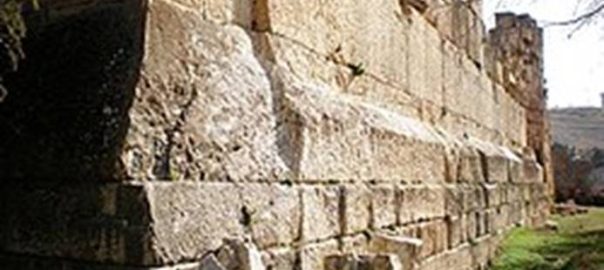
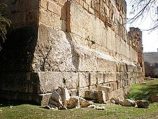
The blocks known as the Trilithon (the upper of the two largest courses of stone pictured) in the Temple of Jupiter Baal

The Trilithon (Greek: Τρίλιθον), also called the Three Stones, is a group of three horizontally lying giant stones that form part of the podium of the Temple of Jupiter Baal at Baalbek. The location of the megalithic structures is atop a hill in the region known as Tel Baalbek. Each one of these stones is 19 metres (62 ft) long, 4.2 metres (14 ft) high, and 3.6 metres (12 ft) thick, and weighs around 750–800 tons (1,650,000–1,760,000 lb). The supporting stone layer beneath features a number of stones which weigh an estimated 350 tons (770,000 lb) and are 11 metres (36 ft) wide.

Although they do not form a trilithon in the modern archaeological sense, they have been known as the Trilithon since at latest the early Byzantine period.

Stone of the Pregnant Woman

Stone of the Pregnant Woman on an early 20th-century lantern slide

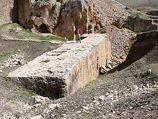
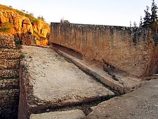
The Stone of the Pregnant Woman (Arabicحجر الحبليromanizedḤajar el-Ḥible), also called the First Monolith, still lies in the ancient quarry at a distance of 900 metres (3,000 ft) from the Heliopolis temple complex.[9] Although the smallest of the three monoliths, it is also the most famous due to its fine condition, the imposing angle at which it lies, and it never having been fully hidden by the earth.

In 1996, a geodetic team of the Austrian city of Linz conducted topographical measurements at the site which aimed at establishing the exact dimensions of the two monoliths and their possible use in the construction of the gigantic Jupiter temple. According to their calculations, the block weighs c. 1,000 tons (2,200,000 lb), thus practically confirming older estimations such as that of Jean-Pierre Adam.

The rectangular stone block is:

  • 20.31–20.76 metres (66.6–68.1 ft) long
  • 4 metres (13 ft) wide at the base
  • 4.14–5.29 metres (13.6–17.4 ft) wide at the top
  • 4.21–4.32 metres (13.8–14.2 ft) high
  • Has an estimated density of 2.6–2.8 g/cm3 (0.094–0.101 lb/cu in)

There are multiple stories behind the name. One says the monolith is named after a pregnant woman who tricked the people of Baalbek into believing that she knew how to move the giant stone if only they would feed her until she gave birth. Others say the name comes from the legends that pregnant jinn were assigned the task of cutting and moving the stone, while others say that the name reflects the belief that a woman who touches the stone experiences an increase in fertility.

Stone of the South

The Stone of the South, discovered at Baalbek in the 1990s and weighing 1,242 tons

The Stone of the South (Arabicحجر القبليromanizedḤajar el-Guble), also called the Second Monolith, was rediscovered in the same quarry in the 1990s. With its weight estimated at 1,242 tons (2,738,000 lb), it surpasses even the dimension of the Stone of the Pregnant Woman.[16] (There is some confusion over the naming, due to its location having been forgotten, and accordingly some sources identify “Stone of the South” as an alternate name of the Stone of the Pregnant Woman.)

These are dimensions of the rectangular stone block, assuming that its shape is consistent in its still-buried parts:

  • 19.5–20.5 metres (64–67 ft) long[
  • 4.34–4.56 metres (14.2–15.0 ft) wide
  • 4.5 metres (15 ft) high
  • Has an estimated density of 2.6–2.8 g/cm3 (0.094–0.101 lb/cu in)

Forgotten Stone

The Third Monolith in situ at Baalbek quarry, on the left beside the Stone of the Pregnant Woman

The Forgotten Stone, also called the Third Monolith, was discovered in the same quarry in 2014 by archaeologists from the German Archaeological Institute. Its weight is estimated at around 1,500 tons (3,300,000 lb).

It is 19.6 metres (64 ft) long, 6 metres (20 ft) wide, and at least 5.5 metres (18 ft) high.

Kevin Randall & MJ 12

Kevin Randall & MJ 12

I have always been fascinated about the MJ 12 group. Kevin Randall does a great job of documenting their existence and purpose.

Case MJ-12: The True Story Behind the Government’s UFO Conspiracies

Kevin Randle, one of the most respected names in Ufology and one of the first to bring the Roswell case to the popular imagination, now turns his attention to another fascinating element of the UFO culture: the MJ–12 documents.

The following link provides all the details. While some have alleged that this document is a hoax, I have not found any specific evidence that supports that accusation and much that tends to support it’s authenticity: https://ia800500.us.archive.org/35/items/majestic-12-documents-for-majic-eyes-only/Eisenhower%20Briefing%20Document_text.pdf

There is also SOM1-1 ( available for download from the Web).