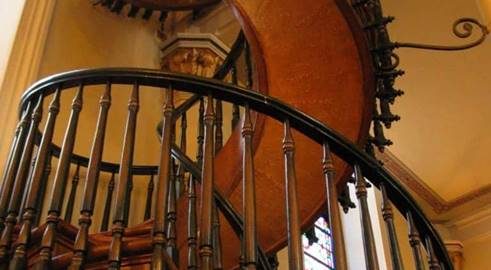
An amazing staircase
The History of the Mysterious Loretto Chapel Staircase
By Carl Seaver
Last updated on January 14th, 2023 at 06:33 pm
Have you ever seen the mysterious spiral Loretto Chapel Staircase? This structure has baffled people for years as there is no logical explanation for building it. Many experts have tried to figure out the mystery behind this miraculous staircase, but no one has come up with a definitive answer.
Let’s explore the history of the Loretto Chapel and try to shed some light on the mysterious staircase.
A Brief History Of The Loretto Chapel
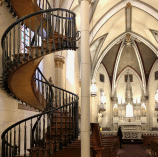
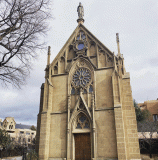
The Loretto Chapel is a historic Catholic chapel in Santa Fe, New Mexico. In 1872, the first Bishop of the diocese commissioned the chapel’s construction, named Our Lady of Light. At the time, the order known as the Sisters of Loretto would maintain the chapel during services. Construction began in 1872, and it was nearly finished by 1878.
The church was constructed in the popular Gothic Revival style by French architect Antoine Mouly. To Bishop Jean-Baptiste Lamy’s dismay, Mouly didn’t live to see the chapel completed. The renowned architect passed away when the chapel was nearly done, leaving the chapel unfinished.
Despite the beauty and craftsmanship of the chapel, it lacked a critical component, a staircase. Without it, the sisters who managed the chapel could not access the choir loft.
What To Do About the Loft?
As the story goes, the chapel was completed in 1878, but there was no way to get to the choir loft, which is 20 feet off the ground. The Sisters believed this to be a test of faith and set out to find a new carpenter to finish the work promptly.
Unfortunately, they met with many carpenters, none of who could provide a solution that worked for the Sisters. Some said it couldn’t be done, while others quoted an outrageous price.
The only option was to use a ladder, which was deemed inappropriate due to the sister’s attire. In 1880, the sisters started praying to the patron saint of carpenters, St. Joseph.
They asked for a solution to their dilemma and prayed for over a week. According to the historical account, on the 9th day, a man arrived on his mule with some tools. He revealed to the Sisters that he was a carpenter by trade, and they eagerly invited him in.
This carpenter was unlike any who had come before him, and shortly after viewing the problem, he admitted that putting a staircase in as possible, even ones that wouldn’t take up too much space or be an eyesore.
His only stipulation was that he was to work in private. Ecstatic, the sisters agreed. Accepting the job, he went outside to his mule, unstrapped his tools, and went to work.
The man worked tirelessly for three months with little rest, and while reports were contradictory, he completed the job by himself with nothing more than the simple tools at his disposal.
Gone Without A Trace
When the carpenter completed the job, he packed up his tools and mule and left. The staircase he built was a thing of beauty and mystery. The Sisters were amazed by what he had accomplished, but they were also mystified about how he did it.
Unfortunately, the carpenter left no blueprint or explanation behind, and to this day, the mystery of how the staircase was constructed remains unsolved.
In addition, the order decided to honor the carpenter’s deed with a banquet, but when it was time to feast, they could not find him. He had disappeared without a trace; he did not identify himself during his time there or ask for payment.
Because his identity remains a secret, the Sisters believed him to be St. Joseph, answering their prayers. With the staircase finished, the chapel was finally complete, but the mystery of its construction was impossible to ignore, and many pondered how the carpenter accomplished the job.
Bottom of Form
The Mysterious Loretto Chapel Staircase
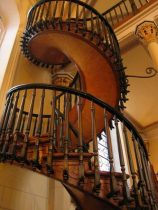
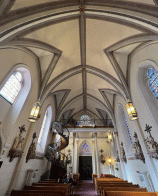
The staircase is known as the “miraculous” or “mysterious” staircase, and it became the main attraction of the Loretto Chapel. It is a double helix staircase that makes two complete 360-degree turns and has no central support. It is made entirely of wood with 33 steps (32 risers and 33 treads) held together by wooden pegs and no glue or nails.
The number of steps is of religious significance because it was Jesus’ age during his crucifixion. This realization only further convinced the sisters and fueled the story that St. Joseph had come to their rescue.
While there are many similar staircases, this one is unique because it was constructed out of wood that was not native to the area. After modern analysis, it turns out that it was a variety of Spruce that is currently unknown.
Researchers thought the closest source for this lumber would have been Alaska, but the idea that someone made the trip transporting lumber from Alaska is implausible. The carpenter also left no blueprints on how the staircase was made, which has led to much debate.
Legends Or Facts?
While the story of the Loretto Chapel is fact and fiction, there is no doubt that the staircase is a thing of wonder. It has been the subject of many studies. Finally, a researcher named Mary J. Straw Cook compiled enough evidence about the chapel to determine a few nuggets of truth.
Bottom of Form
Cook mentions that she found an entry in one of the Sisters’ diaries from 1881 that stated they paid a man name Rochas for wood. Later, Cook found a newspaper article mentioning Mr. Rochas and that he was a skilled woodworker who built the staircase.
According to Cook’s research, Rochas was a member of a secret French society of skilled artisans known as the Compagnons. This order had existed since the Middle Ages. Rochas had come to the U.S. to design the Santa Fe staircase specifically, and the wood came from France.
The Beauty of the Loretto Chapel Staircase
Even with all the advances in technology and engineering, no one can determine how the staircase was built. The stairs are a beautiful and mysterious element of the Loretto Chapel, regardless of the facts around its construction.