There have been changes in this amazing racing vehicle. They have always been able to achieve fabulous HP from very small engines. Following are the latest details (would you have ever imagined a “hybrid?):
“In 2025, Formula 1 will continue to use 1.6-liter V6 turbocharged hybrid engines, a configuration in place since 2014. These power units combine an internal combustion engine (ICE) with sophisticated hybrid systems to deliver high performance and efficiency. The key components include the ICE, Motor Generator Unit-Kinetic (MGU-K), Motor Generator Unit-Heat (MGU-H), turbocharger, energy store, and control electronics. Here’s a more detailed breakdown: Internal Combustion Engine (ICE): A 1.6-liter, 90-degree V6 engine limited to 15,000 rpm, producing around 830-850 horsepower. Regulations limit fuel flow, encouraging efficiency rather than just raw power. MGU-K: An electric motor-generator recovers kinetic energy during braking and can deploy up to 120 kW (160 hp) to assist the engine. MGU-H: Another motor-generator attached to the turbocharger, harvesting exhaust heat energy to either store or use for maintaining turbo speed. Energy Store: A battery pack stores the energy recovered by the MGU-K and MGU-H, delivering it to the MGU-K. Control Electronics: Sophisticated electronics manage the power unit, optimizing performance and efficiency. Engine Suppliers: The four engine suppliers for the 2025 season are Ferrari, Mercedes, Renault, and Honda RBPT. These suppliers provide power units to the ten F1 teams. Renault is ending its engine program after the 2025”
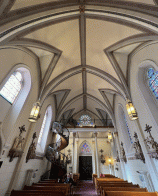
Have you ever seen the mysterious spiral Loretto Chapel Staircase? This structure has baffled people for years as there is no logical explanation for building it. Many experts have tried to figure out the mystery behind this miraculous staircase, but no one has come up with a definitive answer.
Let’s explore the history of the Loretto Chapel and try to shed some light on the mysterious staircase.
A Brief History Of The Loretto Chapel
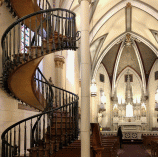
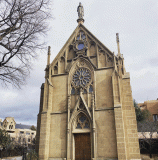
The Loretto Chapel is a historic Catholic chapel in Santa Fe, New Mexico. In 1872, the first Bishop of the diocese commissioned the chapel’s construction, named Our Lady of Light. At the time, the order known as the Sisters of Loretto would maintain the chapel during services. Construction began in 1872, and it was nearly finished by 1878.
The church was constructed in the popular Gothic Revival style by French architect Antoine Mouly. To Bishop Jean-Baptiste Lamy’s dismay, Mouly didn’t live to see the chapel completed. The renowned architect passed away when the chapel was nearly done, leaving the chapel unfinished.
Despite the beauty and craftsmanship of the chapel, it lacked a critical component, a staircase. Without it, the sisters who managed the chapel could not access the choir loft.
What To Do About the Loft?
As the story goes, the chapel was completed in 1878, but there was no way to get to the choir loft, which is 20 feet off the ground. The Sisters believed this to be a test of faith and set out to find a new carpenter to finish the work promptly.
Unfortunately, they met with many carpenters, none of who could provide a solution that worked for the Sisters. Some said it couldn’t be done, while others quoted an outrageous price.
The only option was to use a ladder, which was deemed inappropriate due to the sister’s attire. In 1880, the sisters started praying to the patron saint of carpenters, St. Joseph.
They asked for a solution to their dilemma and prayed for over a week. According to the historical account, on the 9th day, a man arrived on his mule with some tools. He revealed to the Sisters that he was a carpenter by trade, and they eagerly invited him in.
This carpenter was unlike any who had come before him, and shortly after viewing the problem, he admitted that putting a staircase in as possible, even ones that wouldn’t take up too much space or be an eyesore.
His only stipulation was that he was to work in private. Ecstatic, the sisters agreed. Accepting the job, he went outside to his mule, unstrapped his tools, and went to work.
The man worked tirelessly for three months with little rest, and while reports were contradictory, he completed the job by himself with nothing more than the simple tools at his disposal.
Gone Without A Trace
When the carpenter completed the job, he packed up his tools and mule and left. The staircase he built was a thing of beauty and mystery. The Sisters were amazed by what he had accomplished, but they were also mystified about how he did it.
Unfortunately, the carpenter left no blueprint or explanation behind, and to this day, the mystery of how the staircase was constructed remains unsolved.
In addition, the order decided to honor the carpenter’s deed with a banquet, but when it was time to feast, they could not find him. He had disappeared without a trace; he did not identify himself during his time there or ask for payment.
Because his identity remains a secret, the Sisters believed him to be St. Joseph, answering their prayers. With the staircase finished, the chapel was finally complete, but the mystery of its construction was impossible to ignore, and many pondered how the carpenter accomplished the job.
Bottom of Form
The Mysterious Loretto Chapel Staircase
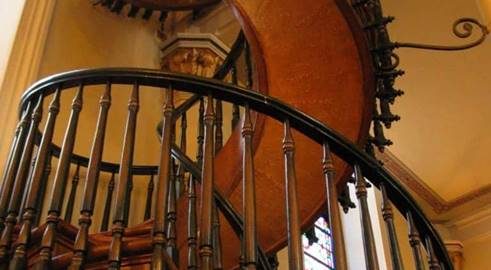
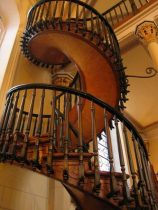
The staircase is known as the “miraculous” or “mysterious” staircase, and it became the main attraction of the Loretto Chapel. It is a double helix staircase that makes two complete 360-degree turns and has no central support. It is made entirely of wood with 33 steps (32 risers and 33 treads) held together by wooden pegs and no glue or nails.
The number of steps is of religious significance because it was Jesus’ age during his crucifixion. This realization only further convinced the sisters and fueled the story that St. Joseph had come to their rescue.
While there are many similar staircases, this one is unique because it was constructed out of wood that was not native to the area. After modern analysis, it turns out that it was a variety of Spruce that is currently unknown.
Researchers thought the closest source for this lumber would have been Alaska, but the idea that someone made the trip transporting lumber from Alaska is implausible. The carpenter also left no blueprints on how the staircase was made, which has led to much debate.
Legends Or Facts?
While the story of the Loretto Chapel is fact and fiction, there is no doubt that the staircase is a thing of wonder. It has been the subject of many studies. Finally, a researcher named Mary J. Straw Cook compiled enough evidence about the chapel to determine a few nuggets of truth.
Bottom of Form
Cook mentions that she found an entry in one of the Sisters’ diaries from 1881 that stated they paid a man name Rochas for wood. Later, Cook found a newspaper article mentioning Mr. Rochas and that he was a skilled woodworker who built the staircase.
According to Cook’s research, Rochas was a member of a secret French society of skilled artisans known as the Compagnons. This order had existed since the Middle Ages. Rochas had come to the U.S. to design the Santa Fe staircase specifically, and the wood came from France.
The Beauty of the Loretto Chapel Staircase
Even with all the advances in technology and engineering, no one can determine how the staircase was built. The stairs are a beautiful and mysterious element of the Loretto Chapel, regardless of the facts around its construction.
In an earlier post I described our family cat, KitKat, managed to escape from the Vet, twice, and return to our home in Montgomery, AL a distance of several miles that required navigating across two Interstate highways. Her feat was by no means unusual. Consider this case:
Willow the Cat Makes History
Willow wandered off five years ago and was found in Manhattan.
By Gabe Pressman • Published September 16, 2011 • Updated on September 16, 2011 at 2:49 pm
It took Ulysses, the Greek hero, 10 years to travel an estimated 565 miles from Troy to Ithaca. Of course, he didn’t have any sophisticated nautical gear, so he may well have been sailing around in circles for thousands of miles.
Willow the Cat has covered 1,600 miles in five years, traveling from Boulder, Colo., to New York City. She was found because of a microchip implanted in her body as a kitten that disclosed her owners’ identities.
Even among cats, a heroic species, Willow is clearly a heroine. As Mayor Bloomberg commented, she may well have decided to give up one of her nine lives just so she could visit New York.
The mayor couldn’t resist taking a slight poke at Willow for taking so long to visit the city. “I don’t know what he was waiting for!”
But the mayor did get the feline’s sex wrong.
Willow’s owners, the Squires family, had given up hope of ever seeing her again. They feared she had been eaten by coyotes after she disappeared five years ago.
But Willow turned up in Manhattan, near the National Arts Club, and she gave cat lovers the world over something to cheer about.
Whether she is a particularly artsy cat is unknown but anyone who has ever witnessed a cat curling up, folding paws, head and tail neatly together, knows that this is a species that has an artistic bent.
Willow is now a celebrity. She has appeared on News 4 New York at 5. Her puss (forgive me) adorns the front pages of tabloids.
The New York Times, a bit stuffily, relegated her to an inside page, below the fold, but she still scored with the paper of record.
Cats have made history for thousands of years. Feline goddesses were worshiped in ancient Egypt 5,000 years ago.
Among some Egyptian royalty, cats were actually allowed to eat off their owners’ plates.
And through the centuries poets and writers just couldn’t get enough of cats.
Leonardo Da Vinci: “The smallest feline is a masterpiece.”
Rosemary Nisbet: “Cats like doors left open, in case they change their minds.”
John R.F. Breen: “Cats pride themselves on their ability to do nothing.”
Ann Taylor: “Dogs eat. Cats dine.”
Mark Twain: “If a man could be crossed with a cat, it would improve man but it would deteriorate the cat.”
Dave Edwards: “Cats are absolute individuals, with their own ideas about everything including the people they own.”
Anyone who has never had a cat jump up on his chest and start purring has missed something important in life. Cats are a constant source of amusement and amazement to me and hundreds of millions of others.
And they do own us. Notice how they always try to go to a piece of furniture that enables them to look down on us.
Mark Twain said that cats are the most intelligent things he knows.
“They are,” he said, “the cleanest, cunningest and most intelligent things I know, outside of the girl you love, of course.”
T.S. Eliot wrote, “Cats are much like you and me and other people whom we find possessed of various types of mind — for some are sane and some are mad — and some are good and some are bad … “
Willow was — excuse the expression — catapulted into worldwide prominence by an act of fate.
Clearly there is nothing, ahem, pusillanimous about this cat.
Her life could have been a catastrophe. Instead, she is famous and justly so.