
Category Archives: Education

learning in America

21b) Life Skills – a bit of background & the history example (con’t)

21b) Life Skills – a bit of background & the history example (con’t)

Regarding the maps used by the Chinese mentioned in the prior blog, who drew them and when. Evidence suggests that they were copies of documents from prior to 2,000 BC!

But were the Norse and Chinese the only explorers to precede Columbus? Again, it appears not. There is circumstantial evidence that the Phoenicians may have made it to America as much as 2,000 years ago, the Ancient Celts around that same time and the Irish & Welsh at some time prior to the Norse. I suspect that we will learn more about these possibilities as our abilities & technology improves.

We now know, through DNA mapping, that as long ago as 24,000 years ago Europeans migrated to Northeast Asia and apparently moved with others to America and that 1/3 of ancient indigenous Americans DNA is of European origins! The assumption is that all of the European DNA is a result of the Asian migration, but there is also evidence of possible migration directly from Europe along the Ice Sheet South of Iceland, Greenland and then on to North America during the Ice Age.

This idea is based on stone age peoples using rather primitive vessels and staying close to the ice shoreline and surviving on hunting and fishing.
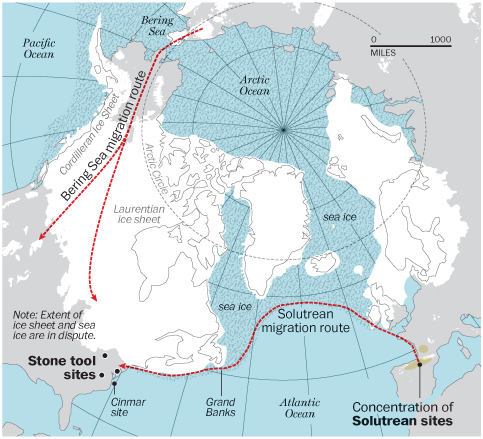
stay tuned for more on this next week


Life skills and the need to incorporate them early into the educational curriculum

Life skills and the need to incorporate them early into the educational curriculum

21a) A bit of Background

One of my biggest concerns is our educational system, especially from middle through high school. I fully agree that the basics are important but I question the value of many other subjects. I won’t examine all of them but let’s take a look at one just as an example:

History: While history is a particular passion of mine. The History channel is my favorite among the hundreds of choices on Dish TV. I actually enjoyed the subject in school. Imagine my surprise when I later learned that some of what I learned and was tested on was untrue! America was discovered by the Italian Christopher Columbus, except there was a slight indication that Leif Erickson may have landed in Canada sometime earlier. It turns out that Norsemen definitely landed in what later became Canada (might not have been Leif?) Leif  migrated to Iceland & then Greenland with his father Eric the Red before making it to North America around 1,000 AD, but recent discoveries have determined that he was not first. It turns out that Columbus was not Italian (most likely Spanish). I’m sure the indigenous folks appreciated being “discovered”.

Let’s see, what I learned is that they all made it to the “New World” during the last ice age by migrating from Northwest Asia. After that they somehow populated all areas of North, Central and South America. While it now appears that this is partially true, there is much more to this history. Textiles and rope fragments found in a Peruvian cave have been dated to around 12,000 years ago, making them the oldest textiles ever found in South America, according to a report in the April issue of Current Anthropology. This would tend to coincide with the approximate date when the Ice Age was ending. However, logic would dictate that the migration would have commenced millennia prior in order for settlement to have reached Peru and also when the Ice Age was more dominant (and water levels would be lower).

But was the route from Northeast Asia the only route for the early Americans? In turns out the answer is most likely not. There is significant evidence that the Chinese developed settlements in the “New World” a full 70 years prior to Columbus’ first sailing. It is said that the Chinese used maps drawn 3,000 years earlier to navigate East. While there is only “circumstantial” evidence for the origin of the maps their use is not disputed.

stay tuned next week for more on this topic

Amazing Precision Tool Work

37(c) Amazing precision tool work

Puma Punku

Above are from Puma Punku, Peru.

Source: http://www.ancient-origins.net/ancient-places-americas/puma-punku-002

“Puma Punku (or Puma Pumku), a mysterious site located in Bolivia, has astounded archaeologists. It is part of a larger archaeological complex known as Tiahuanacu, and is considered to be one of the most important sites of Andean history.

An Austrian explorer named Arthur Posnansky performed a study on Puma Punku back in 1926. According to him and his supporters, Puma Punku is considered to be one of the oldest archaeological sites on the face of Earth, dating back to 13,000 BCE. Another group of archaeologists used the (unreliable) carbon dating method to date the site to about 400 AD.

The most intriguing thing about Puma Punku is the stonework. The red sandstone and andesite stones were cut in such a precise way that it’s as if they were cut using a diamond tool, and they can fit perfectly into and lock with each other. Another phenomenon of engineering is that each stone weighs up to 800 tons.  Interviews with modern day stone masons have revealed that even with today’s advanced technology, it would be almost impossible to replicate the precision observed in the stones found at Puma Punku.”

Regardless of the age, the stone work is amazing!

more on a related subject continues next week!