Renewable energy could power the world within the next 30 years, and wind power is one of the cheapest, most efficient ways to get there. Except 80% of the world’s offshore wind blows in deep waters, where it’s difficult to build wind farms. A new design for a radically different kind of wind turbine could begin to change that.
Hywind is powering around 36,000 British homes, and it has already broken U.K. records for energy output. Wind Catching Systems launched the same year Hywind opened. It claims that one unit could power up between 80,000 and 100,000 European households. In ideal conditions, where the wind is at its strongest, one wind catcher unit could produce up to 400 gigawatt-hours of energy. By comparison, the largest, most powerful wind turbine on the market right now produces up to 80 gigawatt-hours.
[Wind Catching Systems]
There are several reasons for this substantial difference. First, the Wind Catcher is taller-approaching the height of the Eiffel Tower-which exposes the rotor blades to higher wind speeds. Second, smaller blades perform better. Heggheim explains that traditional turbines are 120 feet long and usually max out at a certain wind speed. By comparison, the Wind Catcher’s blades are 50 feet long and can perform more rotations per minute, therefore generating more energy.
The following article is a bit dated but is the key to the viability of hydrogen fuel cell vehicles.
Analysing the future cost of green hydrogen
Green hydrogen is an extremely promising source of energy, with the potential to power industries. Explore our key projections for this renewable energy source.
Insight
December 2, 2022
Share
Green hydrogen is an extremely promising source of energy; it has the potential to power industries while helping countries decarbonise their economies. But it also carries significant uncertainty in terms of demand and production costs. PwC recently analysed the emerging green hydrogen revolution and the current and future production costs of green hydrogen through 2050.
The shift from grey to green hydrogen
Hydrogen has long been produced using industrial processes powered by fossil fuels, particularly natural gas. This so-called grey hydrogen is widely available and inexpensive, costing just €1–2/kilogram. However, the process used to make it is greenhouse gas–intensive.
What is green hydrogen?
Green hydrogen is formed by using renewable energy, such as solar or wind, to power electrolysers that split water molecules into hydrogen and oxygen. Because it relies on renewable energy, green hydrogen is far more environmentally sustainable than traditional energy sources, yet it is also more expensive, at €3–8/kilogram.
As the cost of renewable energy production and electrolyser hardware declines, green hydrogen will become more cost-competitive, making it a viable source for applications ranging from power to transportation to industrial processes.
50%
The projected decrease in green hydrogen production costs by 2030
Potential green hydrogen cost trajectories across global markets
To better understand the potential future production costs of renewable energy around the world, we recently evaluated forecasts for different markets. The key projections from our model include the following:
Hydrogen production costs will decrease by around 50% by 2030 and then continue to fall steadily at a slightly slower rate until 2050.
By 2050, green hydrogen production costs in some parts of the Middle East, Africa, Russia, China, the US and Australia will be in the range of €1/kilogram.
Over the same time period, production costs in regions with limited renewable resources, such as parts of Europe, Japan and Korea, will be more than €2/kilogram, making it likely these markets will import green hydrogen from elsewhere.
Even densely populated regions with good renewable resources will import hydrogen, as land constraints limit the production of green electricity for direct use and conversion to hydrogen.
Priorities for private business and governments
To capitalise on the emerging opportunity, industries, in partnership with governments, need to start implementing pilot projects in order to gain experience and generate efficiencies through learning curves and scale effects. Governments also need to put the correct regulatory framework in place, which can dramatically swing the economics of projects and make countries more competitive in this rapidly growing market.
Our analysis points to a fundamental conclusion: demand for green hydrogen will grow, and the market is still evolving. However, the infrastructure development that will be required takes time and needs to be planned now. By taking the right steps today, countries can claim their rightful stake while advancing national sustainability agendas.
Although the Webb’s mirror diameter is 2.7 times larger than that of the Hubble Space Telescope, it produces images of comparable sharpness because it observes in the longer-wavelength infrared spectrum. The longer the wavelength of the spectrum, the larger the information-gathering surface required (mirrors in the infrared spectrum or antenna area in the millimeter and radio ranges) for an image comparable in clarity to the visible spectrum of the Hubble Space Telescope.
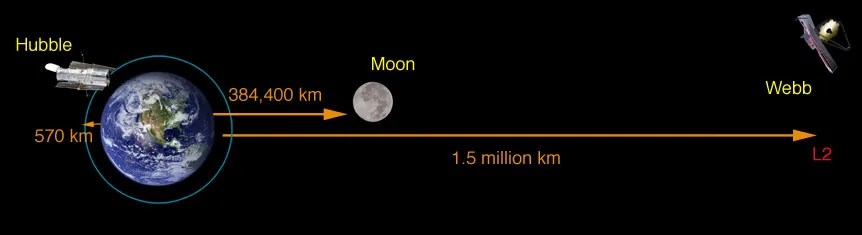
The Webb was launched on 25 December 2021 on an Ariane 5 rocket from Kourou, French Guiana. In January 2022 it arrived at its destination, a solar orbit near the Sun–Earth L2Lagrange point, about 1.5 million kilometers (930,000 mi) from Earth. The telescope’s first image was released to the public on 11 July 2022.
Webb’s primary mirror consists of 18 hexagonal mirror segments made of gold-plated beryllium, which together create a 6.5-meter-diameter (21 ft) mirror, compared with Hubble’s 2.4 m (7 ft 10 in). This gives Webb a light-collecting area of about 25 m2 (270 sq ft), about six times that of Hubble. Unlike Hubble, which observes in the near ultraviolet and visible (0.1 to 0.8 μm), and near infrared (0.8–2.5 μm) spectra, Webb observes a lower frequency range, from long-wavelength visible light (red) through mid-infrared (0.6–28.5 μm). The telescope must be kept extremely cold, below 50 K (−223 °C; −370 °F), so that the infrared light emitted by the telescope itself does not interfere with the collected light. Its five-layer sunshield protects it from warming by the Sun, Earth, and Moon.
Initial designs for the telescope, then named the Next Generation Space Telescope, began in 1996. Two concept studies were commissioned in 1999, for a potential launch in 2007 and a US$1 billion budget. The program was plagued with enormous cost overruns and delays. A major redesign was accomplished in 2005, with construction completed in 2016, followed by years of exhaustive testing, at a total cost of US$10 billion.
A Solar Orbit
The James Webb Space Telescope is not in orbit around the Earth, like the Hubble Space Telescope is – it actually orbits the Sun, 1.5 million kilometers (1 million miles) away from the Earth at what is called the second Lagrange point or L2. What is special about this orbit is that it lets the telescope stay in line with the Earth as it moves around the Sun. This allows the satellite’s large sunshield to protect the telescope from the light and heat of the Sun and Earth (and Moon).
Webb orbits the sun 1.5 million kilometers (1 million miles) away from the Earth at what is called the second Lagrange point or L2. (Note that this graphic is not to scale.)
James Webb Space Telescope orbit as seen from above the Sun’s north pole and as seen from Earth’s perspective.
Getting There
It took roughly 30 days for Webb to reach the start of its orbit at L2, but it took only 3 days to get as far away as the Moon’s orbit, which is about a quarter of the way there. Getting Webb to its orbit around L2 is like reaching the top of a hill by pedaling a bicycle vigorously only at the very beginning of the climb, generating enough energy and speed to spend most of the way coasting up the hill so as to slow to a stop and barely arrive at the top.
Webb at L2
If Webb is orbiting the Sun further out than Earth, shouldn’t it take more than a year to orbit the Sun? Normally yes, but the balance of the combined gravitational pull of the Sun and the Earth at the L2 point means that Webb keeps up with the Earth as it goes around the Sun. The gravitational forces of the Sun and the Earth can nearly hold a spacecraft at this point, so that it takes relatively little rocket thrust to keep the spacecraft in orbit around L2.
Webb orbits around L2; it does not sit stationary precisely at L2. Roughly to scale; it is actually similar in size to the Moon’s orbit around the Earth! This orbit (which takes Webb about 6 months to complete once) keeps the telescope out of the shadows of both the Earth and Moon. Unlike Hubble, which goes in and out of Earth shadow every 90 minutes, Webb has an unimpeded view that allows science operations 24/7.
What is L2?
Joseph-Louis Lagrange was an 18th century mathematician who found the solution to what is called the “three-body problem.” That is, is there any stable configuration, in which three bodies could orbit each other, yet stay in the same position relative to each other? As it turns out, there are five solutions to this problem – and they are called the five Lagrange points, after their discoverer. At Lagrange points, the gravitational pull of two large masses precisely equals the centripetal force required for a small object to move with them.