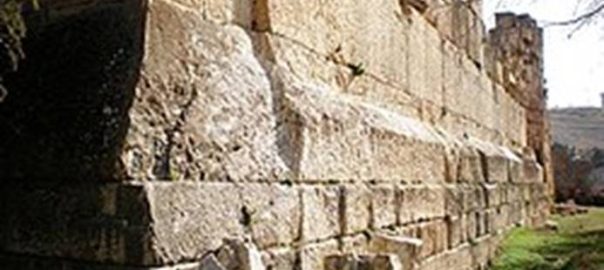
Baalbek – The World’s Largest Stones
I have always been amazed at the massive stones at Baalbek. It’s on my bucket list, but not sure it will ever happen. While some of the pendants suggest that the Romans were responsible that is a ridiculous assertion, in my opinion. For me it is obvious that the Romans took advantage of an existing foundation to exhibit their handiwork. There is no evidence that they had the capability to quarry and relocate stones even a fraction the size of these. The forming and transport of these stones likely preceded the Romans by millennia. We have no clue as to how (or when). Details follow from Wikipedia:
Trilithon
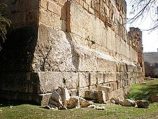

The blocks known as the Trilithon (the upper of the two largest courses of stone pictured) in the Temple of Jupiter Baal
The Trilithon (Greek: Τρίλιθον), also called the Three Stones, is a group of three horizontally lying giant stones that form part of the podium of the Temple of Jupiter Baal at Baalbek. The location of the megalithic structures is atop a hill in the region known as Tel Baalbek. Each one of these stones is 19 metres (62 ft) long, 4.2 metres (14 ft) high, and 3.6 metres (12 ft) thick, and weighs around 750–800 tons (1,650,000–1,760,000 lb). The supporting stone layer beneath features a number of stones which weigh an estimated 350 tons (770,000 lb) and are 11 metres (36 ft) wide.
Although they do not form a trilithon in the modern archaeological sense, they have been known as the Trilithon since at latest the early Byzantine period.
Stone of the Pregnant Woman
Stone of the Pregnant Woman on an early 20th-century lantern slide

The Stone of the Pregnant Woman (Arabic: حجر الحبلي, romanized: Ḥajar el-Ḥible), also called the First Monolith, still lies in the ancient quarry at a distance of 900 metres (3,000 ft) from the Heliopolis temple complex.[9] Although the smallest of the three monoliths, it is also the most famous due to its fine condition, the imposing angle at which it lies, and it never having been fully hidden by the earth.
In 1996, a geodetic team of the Austrian city of Linz conducted topographical measurements at the site which aimed at establishing the exact dimensions of the two monoliths and their possible use in the construction of the gigantic Jupiter temple. According to their calculations, the block weighs c. 1,000 tons (2,200,000 lb), thus practically confirming older estimations such as that of Jean-Pierre Adam.
The rectangular stone block is:
- 20.31–20.76 metres (66.6–68.1 ft) long
- 4 metres (13 ft) wide at the base
- 4.14–5.29 metres (13.6–17.4 ft) wide at the top
- 4.21–4.32 metres (13.8–14.2 ft) high
- Has an estimated density of 2.6–2.8 g/cm3 (0.094–0.101 lb/cu in)
There are multiple stories behind the name. One says the monolith is named after a pregnant woman who tricked the people of Baalbek into believing that she knew how to move the giant stone if only they would feed her until she gave birth. Others say the name comes from the legends that pregnant jinn were assigned the task of cutting and moving the stone, while others say that the name reflects the belief that a woman who touches the stone experiences an increase in fertility.
Stone of the South
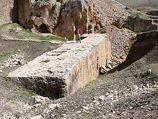

The Stone of the South, discovered at Baalbek in the 1990s and weighing 1,242 tons
The Stone of the South (Arabic: حجر القبلي, romanized: Ḥajar el-Guble), also called the Second Monolith, was rediscovered in the same quarry in the 1990s. With its weight estimated at 1,242 tons (2,738,000 lb), it surpasses even the dimension of the Stone of the Pregnant Woman.[16] (There is some confusion over the naming, due to its location having been forgotten, and accordingly some sources identify “Stone of the South” as an alternate name of the Stone of the Pregnant Woman.)
These are dimensions of the rectangular stone block, assuming that its shape is consistent in its still-buried parts:
- 19.5–20.5 metres (64–67 ft) long[
- 4.34–4.56 metres (14.2–15.0 ft) wide
- 4.5 metres (15 ft) high
- Has an estimated density of 2.6–2.8 g/cm3 (0.094–0.101 lb/cu in)
Forgotten Stone
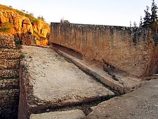

The Third Monolith in situ at Baalbek quarry, on the left beside the Stone of the Pregnant Woman
The Forgotten Stone, also called the Third Monolith, was discovered in the same quarry in 2014 by archaeologists from the German Archaeological Institute. Its weight is estimated at around 1,500 tons (3,300,000 lb).
It is 19.6 metres (64 ft) long, 6 metres (20 ft) wide, and at least 5.5 metres (18 ft) high.