I have always been enamored by cars, especially powerful ones. Upon graduation from university, my dad promised to buy me a new vehicle if the cost did not exceed $3k. There was no doubt that it would be a 335 HP GTO with a 3-speed floor shifter. To keep the price in line I could only afford a few options. No power anything (steering, windows, etc.). I opted for Wide Oval tires and a basic radio. Turning corners took muscle power. This photo could have been my car’s 1963 twin. The 400 cubic inch engine (equivalent to 6.5 liters). It produced an amazing 52 hp per liter.
Later in life, I purchased a Mitsubishi FTO while living in New Zealand. Not considered a muscle car; nevertheless, the 2-liter V6 5-speed manual transmission produced 200 HP. At 100 HP per liter, it was almost double that of the GTO. BTW it had a top speed of 155 MPH about 25 MPH faster than the GTO.
Engine efficiency has come a long way thanks to auto racing. Consider the 2.2-liter Indy Cars that produce 800 HP, almost 400 HP per liter or the even more amazing 1.6-liter Formula 1 cars that produce 1,000 HP (over 600 HP per liter)
The Universe is far too large for most of us to comprehend. There are 3 trillion galaxies in the observable universe and it keeps expanding (as does our ability to observe). Our galaxy is minuscule by comparison but it is still huge at 100,000 light years across. The closest neighbor to our solar system is Andromeda, only 2 ½ light years distant. It is estimated that the Milky Way has between 100 and 400 billion solar systems. Using the midpoint of 250 billion and the estimated number of earthlike planets per solar system at 40% (based on what we have seen) puts the potential planets with life at 100 billion. If only 1% of them have life and of that number, only 1% have intelligent life that still leaves 10 million planets that could provide alien visitors. Forget the universe our galaxy has plenty of potential for intelligent life.
Astronomers have just identified a nearby solar system hosting seven Earth-sized planets. Most intriguing: Three planets that orbit its central star — known as TRAPPIST-1 — may even be within a habitable zone. That means they fall within a region that could support life as we know it. As such, these newfound worlds are good sites to focus a search for alien life.
TRAPPIST-1’s big planetary family also hints that many more cousins of Earth may exist than astronomers had thought.
“It’s rather stunning that the system has so many Earth-sized planets,” says Drake Deming. He’s an astronomer at the University of Maryland in College Park. It seems like every stable spot where a planet could be, there is an Earth-sized one. And that, he adds, “bodes well for finding habitable planets.”
Astrophysicist Michaël Gillon works at the University of Liège in Belgium. He was part of a team that last year announced they had found three Earth-sized planets around TRAPPIST-1. This dwarf star is only about the size of Jupiter. It’s also much cooler than the sun. And it’s a relative neighbor to Earth, a mere 39 light-years away in the constellation Aquarius.
Follow-up observations with the Spitzer Space Telescope and additional telescopes on the ground now show that what first appeared to be a third planet is actually a quartet of Earth-sized ones. Three of these may be habitable.
If those planets have Earthlike atmospheres, their surfaces may even host oceans of liquid water. Or at least that’s what Gillon and his colleagues reported online on February 22 in Nature. Their data also offer signs of a seventh, outermost planet.
In 1979, at the age of 56, Cliff Young competed in the Adidas Sun Superun 16 kilometers (9.9 mi) race which crossed the West Gate Bridge in Melbourne. He ran the race at a very respectable 64 minutes and was interviewed by the media.
Cliff then ran the Melbourne Marathon with a time of 3:21:41 in 1979. He would go on to compete in 1980, 1981, and 1982, setting a personal best of 3:02:53 in 1980, aged 58.
In late 1982, after training for months around the Otway Ranges, Young attempted to break New Zealander Siegfried “Ziggy” Bauer’s then-world record for 1,000 miles (1,600 km) of 11 days and 23 hours. The attempt took place in Colac‘s Memorial Square. Young had to abandon the world record attempt just after halfway at 805 kilometers (500 mi). Reflecting on the failed attempt, Young wrote that he and his support team were inexperienced and ill-prepared.
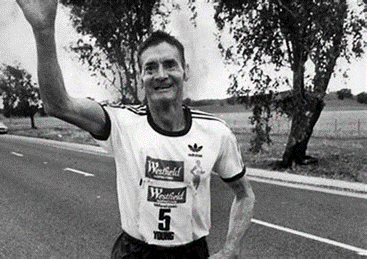
In 1983, now aged 61 years old, Young won the inaugural Westfield Sydney to Melbourne Ultramarathon, a distance of 875 kilometres (544 mi). The race was run between what was then Australia’s two largest Westfield shopping centers: Westfield Parramatta in Sydney and Westfield Doncaster in Melbourne. Young arrived to compete in overalls and work boots, without his dentures (later saying that they rattled when he ran). He ran at a slow and loping pace and trailed the pack by a large margin at the end of the first day. While the other competitors stopped to sleep for six hours, Young kept running. He ran continuously for five days, taking the lead during the first night and eventually winning by 10 hours. Before running the race, he had told the press that he had previously run for two to three days straight rounding up sheep in gumboots (rubber boots). He said afterwards that during the race he imagined he was running after sheep trying to outrun a storm. The Westfield run took him five days, fifteen hours, and four minutes, almost two days faster than the previous record for any run between Sydney and Melbourne, at an average speed of 6.5 kilometers per hour (4.0 mph). All six competitors who finished the race broke the old record. Upon being awarded the prize of A$10,000 (equivalent to $36,011 in 2022), Young said that he did not know there was a prize and that he felt bad accepting it, as each of the other five runners who finished had worked as hard as he did—so he split the money equally between them, keeping none. Despite attempting the event again in later years, Young was unable to repeat this performance or claim victory again.
In 1997, at age 75, he attempted to beat Ron Grant‘s around-Australia record. He completed 6,520 kilometres of the 16,000-kilometre run, but had to pull out because his only crew member became ill
In 2000, Young achieved a world age record in a six-day race in Victoria.