Category Archives: Education

learning in America

Jame Webb

From $1 billon to $10 billion. What does not get publicized (from Wikipedia and others)

The James Webb Space Telescope (JWST) is a space telescope designed to conduct infrared astronomy. As the largest telescope in space, it is equipped with high-resolution and high-sensitivity instruments, allowing it to view objects too old, distant, or faint for the Hubble Space Telescope. This enables investigations across many fields of astronomy and cosmology, such as observation of the first stars and the formation of the first galaxies, and detailed atmospheric characterization of potentially habitable exoplanets.

Although the Webb’s mirror diameter is 2.7 times larger than that of the Hubble Space Telescope, it produces images of comparable sharpness because it observes in the longer-wavelength infrared spectrum. The longer the wavelength of the spectrum, the larger the information-gathering surface required (mirrors in the infrared spectrum or antenna area in the millimeter and radio ranges) for an image comparable in clarity to the visible spectrum of the Hubble Space Telescope.

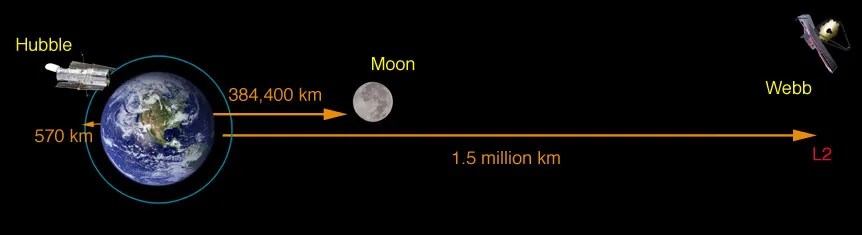
The Webb was launched on 25 December 2021 on an Ariane 5 rocket from Kourou, French Guiana. In January 2022 it arrived at its destination, a solar orbit near the Sun–Earth L2 Lagrange point, about 1.5 million kilometers (930,000 mi) from Earth. The telescope’s first image was released to the public on 11 July 2022.

The U.S. National Aeronautics and Space Administration (NASA) led Webb’s design and development and partnered with two main agencies: the European Space Agency (ESA) and the Canadian Space Agency (CSA). The NASA Goddard Space Flight Center in Maryland managed telescope development, while the Space Telescope Science Institute in Baltimore on the Homewood Campus of Johns Hopkins University operates Webb. The primary contractor for the project was Northrop Grumman.

The telescope is named after James E. Webb, who was the administrator of NASA from 1961 to 1968 during the Mercury, Gemini, and Apollo programs.

Webb’s primary mirror consists of 18 hexagonal mirror segments made of gold-plated beryllium, which together create a 6.5-meter-diameter (21 ft) mirror, compared with Hubble’s 2.4 m (7 ft 10 in). This gives Webb a light-collecting area of about 25 m2 (270 sq ft), about six times that of Hubble. Unlike Hubble, which observes in the near ultraviolet and visible (0.1 to 0.8 μm), and near infrared (0.8–2.5 μm) spectra, Webb observes a lower frequency range, from long-wavelength visible light (red) through mid-infrared (0.6–28.5 μm). The telescope must be kept extremely cold, below 50 K (−223 °C; −370 °F), so that the infrared light emitted by the telescope itself does not interfere with the collected light. Its five-layer sunshield protects it from warming by the Sun, Earth, and Moon.

Initial designs for the telescope, then named the Next Generation Space Telescope, began in 1996. Two concept studies were commissioned in 1999, for a potential launch in 2007 and a US$1 billion budget. The program was plagued with enormous cost overruns and delays. A major redesign was accomplished in 2005, with construction completed in 2016, followed by years of exhaustive testing, at a total cost of US$10 billion.

A Solar Orbit

The James Webb Space Telescope is not in orbit around the Earth, like the Hubble Space Telescope is – it actually orbits the Sun, 1.5 million kilometers (1 million miles) away from the Earth at what is called the second Lagrange point or L2. What is special about this orbit is that it lets the telescope stay in line with the Earth as it moves around the Sun. This allows the satellite’s large sunshield to protect the telescope from the light and heat of the Sun and Earth (and Moon).

Webb orbits the sun 1.5 million kilometers (1 million miles) away from the Earth at what is called the second Lagrange point or L2. (Note that this graphic is not to scale.)

James Webb Space Telescope orbit as seen from above the Sun’s north pole and as seen from Earth’s perspective.

Getting There

It took roughly 30 days for Webb to reach the start of its orbit at L2, but it took only 3 days to get as far away as the Moon’s orbit, which is about a quarter of the way there. Getting Webb to its orbit around L2 is like reaching the top of a hill by pedaling a bicycle vigorously only at the very beginning of the climb, generating enough energy and speed to spend most of the way coasting up the hill so as to slow to a stop and barely arrive at the top.

Webb at L2

If Webb is orbiting the Sun further out than Earth, shouldn’t it take more than a year to orbit the Sun? Normally yes, but the balance of the combined gravitational pull of the Sun and the Earth at the L2 point means that Webb keeps up with the Earth as it goes around the Sun. The gravitational forces of the Sun and the Earth can nearly hold a spacecraft at this point, so that it takes relatively little rocket thrust to keep the spacecraft in orbit around L2.

Webb orbits around L2; it does not sit stationary precisely at L2. Roughly to scale; it is actually similar in size to the Moon’s orbit around the Earth! This orbit (which takes Webb about 6 months to complete once) keeps the telescope out of the shadows of both the Earth and Moon. Unlike Hubble, which goes in and out of Earth shadow every 90 minutes, Webb has an unimpeded view that allows science operations 24/7.

What is L2?

Joseph-Louis Lagrange was an 18th century mathematician who found the solution to what is called the “three-body problem.” That is, is there any stable configuration, in which three bodies could orbit each other, yet stay in the same position relative to each other? As it turns out, there are five solutions to this problem – and they are called the five Lagrange points, after their discoverer. At Lagrange points, the gravitational pull of two large masses precisely equals the centripetal force required for a small object to move with them.

Convert Air into Energy

Convert Air into Energy

A team of scientists have discovered an enzyme that converts air into energy

The finding, published in the top journal Nature, reveals that this enzyme uses the low amounts of the hydrogen in the atmosphere to create an electrical current. This finding opens the way to create devices that literally make energy from thin air.

The research team, led by Dr Rhys Grinter, Ashleigh Kropp, and Professor Chris Greening from the Monash University Biomedicine Discovery Institute in Melbourne, Australia, produced and analyzed a hydrogen-consuming enzyme from a common soil bacterium. Molecular modelling and simulations were performed by Oxford Biochemistry and Queens College undergraduate Jack Badley and postdoctoral research fellow Dr Ruyu Jiya, under the supervision of Professor Syma Khalid (Professor of Computational Microbiology in the Department of Biochemstry, Oxford). Professor Chris Greening is also an alumnus of the Department of Biochemistry at Oxford.

Many bacteria use hydrogen from the atmosphere as an energy source in nutrient-poor environments. In this Nature paper, the researchers extracted the enzyme responsible for using atmospheric hydrogen from a bacterium called Mycobacterium smegmatis. They showed that this enzyme, called Huc, turns hydrogen gas into an electrical current. The enzyme is extraordinarily efficient and is able to consume hydrogen below atmospheric levels – as little as 0.00005% of the air we breathe.

The researchers used several cutting-edge methods to reveal the molecular blueprint of atmospheric hydrogen oxidation. They used advanced microscopy (cryo-EM) to determine its atomic structure and electrical pathways, pushing boundaries to produce the most resolved enzyme structure reported by this method to date. Electrochemistry was used to demonstrate the purified enzyme creates electricity at minute hydrogen concentrations. Molecular modelling and simulations were used to identify the specific regions of the protein which allow hydrogen gas to enter the active site of the protein where it is transformed, but prevent oxygen getting through.

Huc is a “natural battery” that produces a sustained electrical current from air or added hydrogen. While this research is at an early stage, the discovery of Huc has considerable potential to develop small air-powered devices, for example as an alternative to solar-powered devices.

The bacteria that produce enzymes like Huc are common and can be grown in large quantities, meaning we have access to a sustainable source of the enzyme. Dr. Grinter says that a key objective for future work is to scale up Huc production. “Once we produce Huc in sufficient quantities, the sky is quite literally the limit for using it to produce clean energy.”

Syma Khalid: Jack Badley, an undergraduate student doing a research project in my group used computer simulations to show how the channels to the active site of Huc are too narrow for oxygen to pass through, but wide enough for hydrogen. Extension of Jack’s work by Ruyu Jia predicted mutations that would widen these channels to enable passage of oxygen. It was wonderful for us to work with the remarkably high-quality structure determined by the Monash team, and I think for all of us it really showed the power of doing experimental and simulation work in tandem.

Key UN reports published warn urgent and collective action needed

Key UN reports published warn urgent and collective action needed – as oil firms report astronomical profits

By Damian Carrington Environment editor

The climate crisis has reached a “really bleak moment”, one of the world’s leading climate scientists has said, after a slew of major reports laid bare how close the planet is to catastrophe.

Collective action is needed by the world’s nations more now than at any point since the second world war to avoid climate tipping points, Prof Johan Rockström said, but geopolitical tensions are at a high.

He said the world was coming “very, very close to irreversible changes … time is really running out very, very fast”.

Emissions must fall by about half by 2030 to meet the internationally agreed target of 1.5C of heating but are still rising, the reports showed – at a time when oil giants are making astronomical amounts of money.

On Thursday, Shell and TotalEnergies both doubled their quarterly profits to about $10bn. Oil and gas giants have enjoyed soaring profits as post-Covid demand jumps and after Russia’s invasion of Ukraine. The sector is expected to amass $4tn in 2022, strengthening calls for heavy windfall taxes to address the cost of living crisis and fund the clean energy transition.

All three of the key UN agencies have produced damning reports in the last two days. The UN environment agency’s report found there was “no credible pathway to 1.5C in place” and that “woefully inadequate” progress on cutting carbon emissions means the only way to limit the worst impacts of the climate crisis is a “rapid transformation of societies”.

Current pledges for action by 2030, even if delivered in full, would mean a rise in global heating of about 2.5C, a level that would condemn the world to catastrophic climate breakdown, according to the UN’s climate agency. Only a handful of countries have ramped up their plans in the last year, despite having promised to do so at the Cop26 UN climate summit in Glasgow last November.

The UN’s meteorological agency reported that all the main heating gases hit record highs in 2021, with an alarming surge in emissions of methane, a potent greenhouse gas.

Separately, the IEA’s world energy report offered a glimmer of progress, that CO2 from fossil fuels could peak by 2025 as high energy prices push nations towards clean energy, though it warned that it would not be enough to avoid severe climate impacts.

Rockström, director of the Potsdam Institute for Climate Impact Research in Germany, said: “It’s a really bleak moment, not only because of the reports showing that emissions are still rising, so we’re not delivering on either the Paris or Glasgow climate agreements, but we also have so much scientific evidence that we are very, very close to irreversible changes – we’re coming closer to tipping points.”

Research by Rockström and colleagues, published in September, found five dangerous climate tipping points may already have been passed due to the global heating caused by humanity to date, including the collapse of Greenland’s ice cap, with another five possible with 1.5C of heating.

“Furthermore, the world is unfortunately in a geopolitically unstable state,” said Rockström. “So when we need collective action at the global level, probably more than ever since the second world war, to keep the planet stable, we have an all-time low in terms of our ability to collectively act together.”

“Time is really running out very, very fast,” he said. “I must say, in my professional life as a climate scientist, this is a low point. The window for 1.5C is shutting as I speak, so it’s really tough.”

His remarks came after the UN secretary general, António Guterres, said on Wednesday that climate action was “falling pitifully short”. “We are headed for a global catastrophe [and] for economy-destroying levels of global heating.”

He added: “Droughts, floods, storms and wildfires are devastating lives and livelihoods across the globe [and] getting worse by the day. We need climate action on all fronts and we need it now.” He said the G20 nations, responsible for 80% of emissions, must lead the way.

Inger Andersen, head of the UN environment program (UNEP), told the Guardian that the energy crisis must be used to speed up delivery of a low-carbon economy: “We are in danger of missing the opportunity and a crisis is a terrible thing to waste.”